
The preceding post in this series outlined the benefits of watching your thoughts and impulses pass—acknowledging them, but not attaching to or indulging them. This ability to prevent yourself from becoming lost in thought is developed with habitual mindfulness practice, but it becomes much easier when you don’t overburden yourself with stimulation.
One phrase I like to use to express the practice of limiting exposure to sensory impressions – in particular to media – is a “low-information diet.” While author Tim Ferriss – who coined the term in his book, The 4-Hour Workweek – spoke primarily of its benefits on productivity, it certainly can have profound effects on overall life satisfaction.
Simplicity leads to gratitude, enjoyment of what you have, and immersion in it because of lack of other available options.
The internet’s wonderful because of all the knowledge it can bring you at the click of a mouse. But if it weren’t for it, I’d be none the wiser about all the things I’m missing out on—and would likely be more present to and better able to enjoy the ones I’m already conscious of.
Satisficing and Maximizing
At a certain point, I couldn’t even enjoy listening to music anymore – my all-time favorite pastime – because instead of mindfully engaging with it, I was always seeking what song would be next or pondering what else “better” was out there I was missing out on. I knew it was a sad state of affairs when I couldn’t even recall the song I had been listening to two tracks prior.
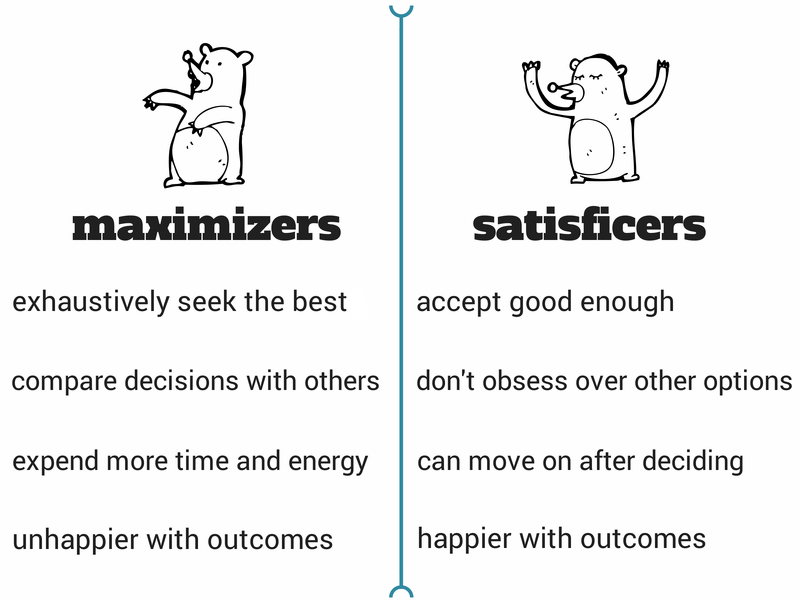
I started maximizing my first true love, and strangled it. Having a world (wide web) of distraction at the click of a mouse certainly didn’t help, but I’m not one to play the victim… I did it to myself by choosing to subject myself to overstimulation.
CD Baby founder and entrepreneur Derek Sivers is quoted as saying, “If you have fun optimizing, then it’s worth it.” But because of all the available options and my inability to stay centered and fight off impulsivity, even just listening to music became stress-inducing instead of relaxing—a job instead of a meditative activity.
I’m a devout music digger, and as such, was always trying to find the perfect soundtrack to accompany me in whatever I was doing, which caused a lot of wasted time and mental expenditure.
My “life’s work” had become curating the ultimate music playlist. I was a mere cog in the wheel of creativity instead of utilizing the creative juices instilled in me by the Supreme Being.
Since I was constantly on my computer, and often my only constraints were those I placed on myself, I let that freedom get the better of me. Instead of getting down to business writing, I spent all my time compiling songs I discovered via Spotify or in a DJ mix which touched my soul into an ultimate playlist, or adding the LPs they appeared on to my wantlist on Discogs (a database for record collectors).
And in the rare instance I had gotten into the creative rhythm, since the music I listened to was typically new to me, there was no telling if it would make good background music. Thus, I was frequently presented with songs that weren’t conducive to concentration, actively subjecting myself to agitation and losing my flow when switching tasks to change the music if it didn’t gel with what I was doing.
Even when I encountered a track I loved, I would break from what I was doing in order to bookmark it to revisit later, often causing me to lose my train of thought.
Singular Focus
Personally, I’ve come to prefer simplicity—having a ton of attachments to account for, incessant deliberation, or trying to focus attention between multiple stimuli is exhausting. All these inconsequential decisions burn as much glucose in the brain as significant, high-involvement ones.
Mentally exhausted from all these petty decisions and considerations, I had little expenditure left when it came time for the truly critical stuff.
The default mode network of my brain (monkey mind) was always active, preventing my mind from sitting in neutral and charging my battery in a state of alert relaxation. This cognitive stimulation overload from constantly being in decision-making mode can also manifest physically, burning out your Jing—all it took was one glance at my face for it to be apparent how afflicted I was inside.
Now I often opt not to listen to music when I’m already engaged with something else if I feel adding that component is overstimulating. For example, while music still pumps me up while skateboarding, I’ve found that multitasking detracts from my immersion in both activities. My skating performance and enjoyment/encoding of the music both take a dive—I’m the most in the flow when I make myself fully available to each.
By stopping consuming media while eating, I’m better able to appreciate the subtleties in flavor, richness and textures of food where I didn’t used to.
In addition to appreciation for it, dedicating all of your being to a sole endeavor will improve your centeredness, mental clarity, creativity, and ultimately, performance. The experience will also stay with you longer because you’ve lightened the cognitive load during the process.
The cherry on top is gaining novel insights that others could be receptive to, but miss because their awareness was divided between several things.
In fact, the main reason I only had creative, insightful thoughts while laying in bed at night behind the protection of my shut door was because that was the only time I wasn’t self-conscious or my mind wasn’t preoccupied with what I could be doing or what else I could consume next to maximize my existence.
Boredom and simplicity make creativity much more likely to strike. It’s kinda like flying a kite with a key on it during a lightning storm.
A minimalistic approach makes you more present, and thus receptive to insight. And just like with simplicity itself, organizing your space and time lightens the extraneous (unnecessary) cognitive load immensely.
 Conscious Consumption